15 Hidden Wedding Costs That Blow Your Budget
March 22, 2026 · 7 min read
Here's a stat that should make every engaged couple sit up straight: hidden costs typically add 9–15% to your total wedding spend beyond your original vendor quotes. On a $30,000 wedding, that's an extra $2,700 to $4,500 you didn't plan for.
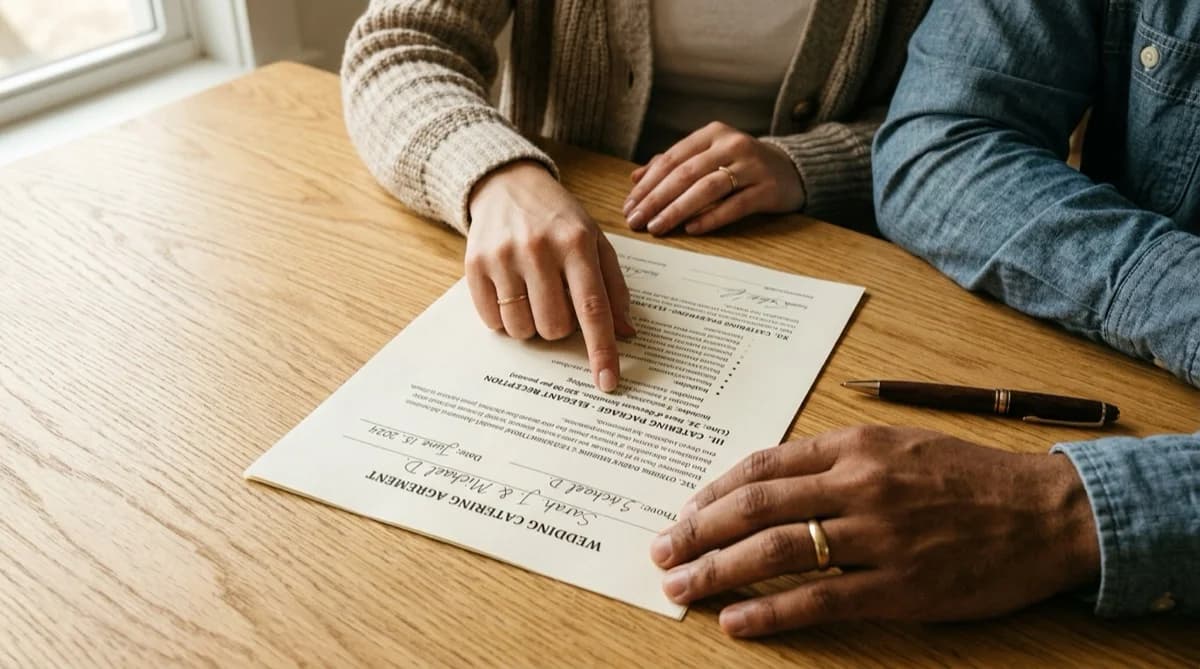
The frustrating part? These aren't luxuries you chose to add. They're fees, charges, and forgotten line items that almost every couple discovers too late — usually when the final invoices land. The best defense is knowing they exist before you sign a single contract. So let's walk through the fifteen that catch couples off guard the most.
The Big Ones That Change Your Whole Number
1. The Catering Service Charge
This is the single biggest surprise on most couples' final bill. Almost every venue and caterer adds a mandatory service charge of 18–25% on all food and beverage. That means your $15,000 catering quote actually costs $18,000 to $18,750 once this fee is applied.
Here's the kicker: a service charge is usually not a tip for your servers.It typically covers the caterer's overhead — equipment, logistics, administrative costs, and operational expenses. Your servers may see none of it. When a venue quotes you “$150 per person,” those two little plus signs after the number (as in $150++) mean taxes and service charge are coming on top.
2. Vendor Gratuity (Yes, On Top of the Service Charge)
Since the service charge often doesn't go to the people actually working your wedding, you're still expected to tip them separately. Photographer, DJ, hair and makeup artists, coordinator, bartenders, servers, transportation drivers — it adds up fast.
For a typical 100-person wedding, vendor tips alone can run $500 to $1,500+. The amounts vary by role, but the key point is that this is a separate budget line from whatever “service fee” appears in your contracts. If you assumed that 22% charge covered tips, you're not alone — and you're in for an unpleasant surprise.
3. Sales Tax on Everything
This one sounds obvious, but couples consistently forget to apply sales tax to their estimates. Depending on your state, sales tax of 6–10% is applied on top of your catering subtotal, including the service charge. That means tax is calculated on an already-inflated number. A $15,000 food and drink bill can become $19,000+ once you stack the service charge and tax together.
The Pre-Wedding Costs Nobody Budgets For
4. Engagement Party Expenses
Someone might throw you an engagement party, but you'll still likely spend on a new outfit, drinks for the host, and possibly a venue contribution. Budget $200–$500you probably didn't account for.
5. Bridal Shower and Bachelor/ette Weekends
Even if you're not the one planning these, there are costs: outfits, travel, accommodations, matching accessories, and group activities. Many couples report spending $500–$2,000+ eachon pre-wedding events they didn't include in their original wedding budget.
6. Rehearsal Dinner
Traditionally the groom's family covers this, but that's increasingly the couple's responsibility. A restaurant dinner for 20–40 people can easily run $1,500–$5,000depending on your city and venue choice. If nobody's explicitly claimed this cost, it's landing on your tab.
These costs are already in your RingTally budget templates
RingTally builds from real wedding spending data — vendor gratuities, alterations, postage, and service charges come pre-loaded as line items. Free to start, no credit card required.
See how it worksVenue and Vendor Fees That Appear After You Book
7. Rental Delivery, Setup, and Pickup Charges
You budgeted for the tables, chairs, linens, and dance floor rentals. But the cost of trucking them to your venue, setting them up, and picking them up afterward? That's often billed separately — sometimes $300–$800+ per delivery. If you're using multiple rental companies, multiply accordingly.
8. Vendor Meals
Every vendor on-site for more than four hours — photographer, videographer, DJ, planner, band members — needs to eat. Most contracts require it. Your caterer will charge you $30–$90 per vendor meal, and at a full-service wedding, you might be feeding six to twelve people you didn't count in your guest list.
9. Room Flip and Ceremony-to-Reception Conversion Fees
If your ceremony and reception are in the same space, someone has to rearrange the room in between. Some venues include this; many charge a separate “room flip” or “turnover” fee of $500–$1,500 depending on the complexity.
10. Overtime Charges
Your venue contract probably specifies a hard end time. If your reception goes even thirty minutes over, expect overtime fees — often $500–$1,500 per hour — for the venue, DJ, photographer, and any other vendor with a time cap in their contract.
11. Cake Cutting Fees
Bringing in a cake from your favorite bakery instead of using the venue's preferred vendor? Many venues charge a cake cutting fee of $1–$7 per guestto slice and serve it. At 150 guests, that's up to $1,050 for the privilege of someone cutting your cake.
The “Small Stuff” That Quietly Adds Up
12. Invitation Postage
A standard wedding invitation suite — inner envelope, outer envelope, RSVP card, RSVP envelope, and information insert — is heavier than you think. Postage can run $1.50–$3.00+ per invitationonce you factor in weight, square formatting surcharges, and RSVP return stamps. For 100 households, that's $150–$300 just in stamps.
13. Dress Alterations and Steaming
The price tag on the dress is never the final price. Hemming, bustle additions, taking in the bodice, and adding straps or cups can cost $200–$800+ in alterations alone.Steaming the day before the wedding is another $50–$100. If you're preserving the dress afterward, add another $200–$400.
14. Hair and Makeup Trials
Your stylist will almost certainly recommend a trial run before the big day — and it's smart to do one. But trials are usually $150–$350 eachand often not included in the day-of pricing. If you're doing both hair and makeup trials, that's an extra $300–$700 before you've even gotten to the wedding morning.
15. Marriage License and Officiant Fees
The most important piece of paper of the whole day, and couples routinely forget to budget for it. Marriage license fees range from $25–$115depending on your state and county. Officiant fees — if you're hiring one rather than having a friend do it — typically run $200–$600 on top of that.
How to Make Sure These Don't Catch You Off Guard
Reading a list like this can feel overwhelming, but the actual fix is simple: you just need a budget that accounts for them from the start.The problem isn't that these costs are unreasonable — it's that most couples build their budget around the big-ticket vendor quotes and never create line items for the fees, taxes, tips, and pre-wedding expenses that surround them.
That's exactly why RingTally's budget templates are built from real wedding spending data — not just the highlight reel. When you set up your budget in RingTally, items like vendor gratuities, alteration costs, postage, and service charges are already there as line items waiting to be filled in. You're not going to forget them because they're not hiding anymore. And as each vendor quote comes in, you can attach contracts and track every payment from deposit to final balance, so nothing slips through the cracks.
The couples who stay on budget aren't the ones who spend less. They're the ones who knew what was coming. Now you do too.
Ready to take control of your wedding budget?
RingTally makes it easy to track every expense, manage contributions from family, and never miss a vendor payment.
Start for free